
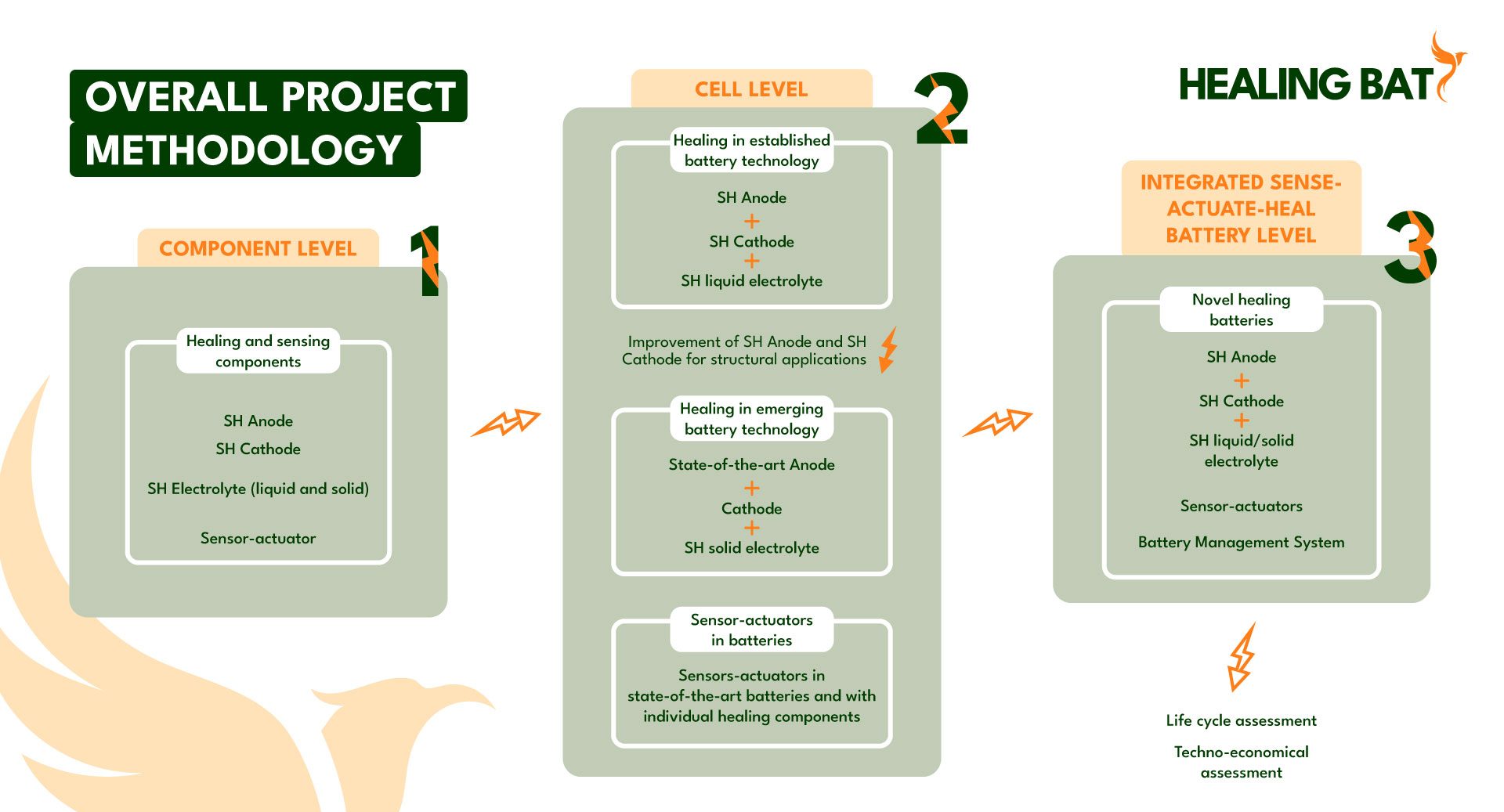
Self-healing batteries are gaining attention as a way to extend battery lifetime, improve safety, and reduce lifecycle costs by addressing degradation earlier before it becomes irreversible. In the Electric & Hybrid Vehicle Technology feature “Battery, heal thyself”, HEALING BAT is highlighted as a project advancing an integrated “sense and heal” approach to self-healing batteries, combining materials innovation with monitoring and validation in real operating conditions.
Why self-healing batteries matter
Battery performance declines over time because normal operation gradually introduces damage in electrodes, separators and electrolytes, reducing capacity and reliability.
For EVs and stationary storage, this can mean reduced range and more frequent replacement, increasing total cost of ownership and environmental impact—exactly the kind of burden next-generation battery R&I aims to reduce.
Intrinsic vs extrinsic self-healing (the basics)
The feature describes two complementary routes to self-healing:
Beyond materials: why sensing and control are essential
Self-healing must happen at the right time; otherwise, repair may be too slow or incomplete. The feature emphasises that monitoring signals (such as temperature/voltage/resistance/stress) can inform a control layer that activates healing actions.
HEALING BAT explicitly adopts this systems perspective, pairing healing strategies with sensing/monitoring and a bespoke Battery Management System (BMS) concept.
HEALING BAT in context (Horizon Europe + LiS focus)
HEALING BAT is a Horizon Europe project running 1 June 2023–31 May 2027, focused on advanced sensing, monitoring and self-healing mechanisms to self-repair batteries.
Its technical focus includes implementing sel-fhealing concepts in key battery components, initially demonstrated in lithium-sulphur (LiS) systems, while building transferable knowledge for more resilient batteries.
The HEALING BAT “toolbox”: materials + sensors + BMS
The same “heal thyself” narrative also flags practical barriers: adding new materials, sensor layers or healing agents must be compatible with manufacturing, cost constraints, and verification under real world cycling. A key differentiator highlighted across public project descriptions is HEALING BAT’s ambition to deliver a toolbox combining:
This “materials + intelligence” approach aims to improve battery reliability, safety and lifetime by detecting degradation events and initiating corrective/healing responses.
Great collaboration can still fall short if each team interprets integration differently. ... Read More
To ensure that results from different laboratories are directly comparable, we introduced ... Read More
From single sensors to coordinated arrays HEALING BAT’s WP3 has reached&... Read More



Funded by the European Union. Views and opinions expressed are however those of the author(s) only and do not necessarily reflect those of the European Union or the European Climate, Infrastructure and Environment Executive Agency (CINEA). Neither the European Union nor the granting authority can be held responsible for them.